Showing posts with label #nutrition. Show all posts

10 April 2018

And this time it is Strawberries in the poly houses of Nepal

Maya Tamang a 40 years old woman lives in Gamailo and was selected as one of the farmers for poly house beneficiaries in Nuwakot district of Kakani Gaupalika. Maya has a family of 7 members and has 2 children. Being illiterate, Maya Tamang did not have enough alternatives for livelihood which made her a potential beneficiary and work as a farmer for poly house in Nuwakot District of Kakani Gaupalika.

Looking at the development indicators of life of villagers, Pragya implemented the project called “Improving Rural Livelihoods, Water & Sanitation in Earthquake Damaged Areas of Nepal” where a holistic rehabilitation programme is being delivered in Nepal. Current interventions are aimed at addressing critical needs of poor households affected by the earthquake in four disaster-affected districts in Nepal. The interventions are focussed on water and sanitation, short-term income generation, long-term livelihood development and protection of women from gender-based violence.

Selected as one of the livelihood package beneficiaries under the project, Maya decided to take this opportunity in the hope of providing better support to her family. Under the project staff’s supervision, she adopted poly house for strawberry production. After receiving support for the polyhouse like silpaulin sheet and bamboo, she zealously spent her time on the construction of poly house. Furthermore, the number of training she received from other organization during the previous year helped her to implement the technology, appropriately.

Maya Tamang in her polyhouse where she has planted strawberry
The variety of strawberries cultivated in Nepal requires an altitude of 1500 - 2500m with a temperature range of 4 - 25 degree Celsius and 3000 - 4000 ml of rainfall, making Kakani the ideal location for such cultivation. The preparation for strawberry cultivation begins around the month of June. After the months of tending, the actual plantation is carried out during September and the produce is ready by November.

Before planting strawberry in poly house, Maya Tamang used to cultivate maize in her farmland. During that time the income she incurred was very less which was not sufficient for her family. But after the strawberry cultivation in the poly house, she is able to have a good yield. In Maya’s words, it was not only her effort alone, her family members have also contributed equally to the cultivation of the strawberries. They helped in watering the plants and put fertilizers and nutrients regularly in the soil. Maya has already sold about 100 kg of strawberry this season and earns 30,000 INR and is still selling the strawberries. Her target is to achieve an income of 1, 50,000 INR. She is happy and satisfied with what she has gained and wants to work harder to make more money from the strawberry fields.

Strawberry in Maya Tamang's polyhouse
“We have seen difficult times when we did not have money to pay for children’s school books for school. Now life has become easier as we are able to manage our daily expenses smoothly,” says Maya Tamang.


Together, Maya and her family have planned to save half of their income for their children’s education and invest the other half to buy food grains that will keep them secure for the entire year. She wants to bring women in the community together, who are interested in strawberry farming along with her and are willing to develop micro-entrepreneurs so that the women in that area do not have to migrate to other places in search of work which will also help in stopping human trafficking in this area.

10 September 2014

Addressing nutrition - the Pragya way...

Food insecurity, hunger and malnutrition continue to pose a major challenge for development, globally. The Himalayan belt, a particularly remote and backward region, where food production is constrained by the terrain and severe climatic conditions, and the problems are compounded due to weak infrastructure, displays the worst food insecurity and nutritional status, with maximum impacts on women. Pragya is addressing these concerns through three broad strategies: (i) Women’s nutri-gardens and Nutrition Watch: small agricultural initiatives for women to increase family food security and nutritional levels; (ii) Nutrient-dense montane farming: agricultural practices and technologies which address nutrient deficiencies; and (iii) Himalayan agri-production scale-up: agricultural improvements for improving land productivity and crop yields to enhance farm incomes.
In Kinnaur district in the western Himalayas, early detection of high iron deficiency (Hb 7.0) in a women’s group member, by the women’s care and ‘Hunger & Nutrition Watch’ processes, and appropriate and sustained dietary intake via growing of cabbage and spinach crops in Nutri-Gardens helped the woman farmer achieve acceptable Haemoglobin levels (Hb 11.0). Women's groups in Sikkim, Darjeeling as well have shown keen interest in managing their home gardens and poly-houses for year round production.


8 August 2014

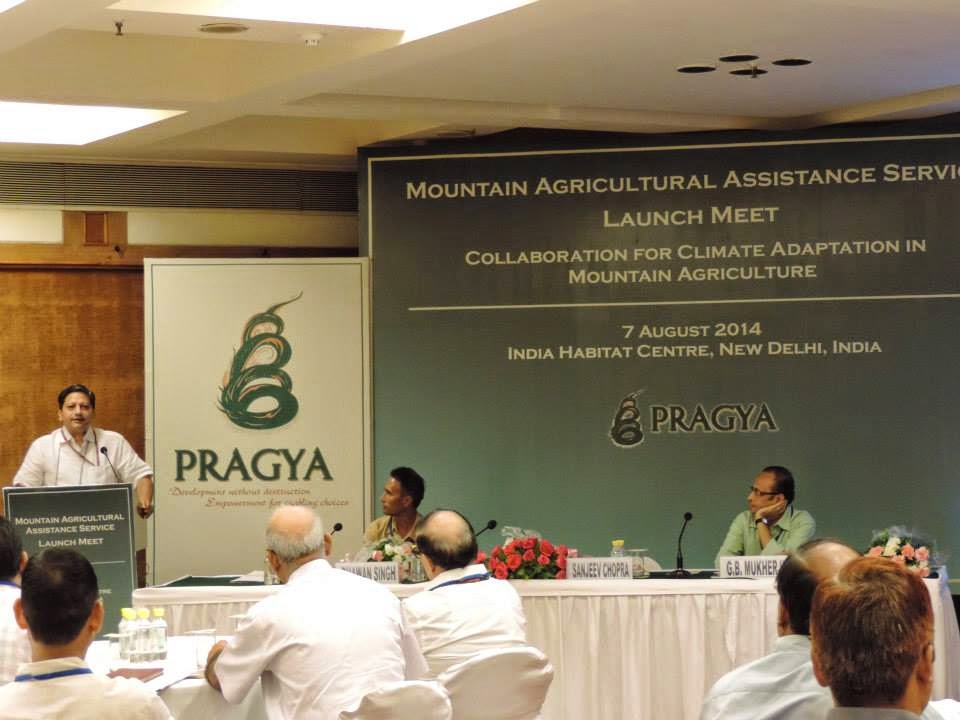
Mountain Agricultural Assistance Service Launch

Pragya organised a national workshop to initiate a multi- stakeholder network: Mountain Agricultural Assistance Service (MAAS). The event held on 7th August, 2014, at India Habitat Centre, New Delhi, India was inaugurated by Dr. Sanjeev Chopra, Jt. Secretary, Ministry of Agriculture – Govt. of India and had participation from national, regional and local institutions, government & non-governmental, as well as experts on mountain agriculture.

The workshop was designed to facilitate interaction among the participants to document the existing pool of knowledge and support services and draw out recommendations for functioning of the MAAS network and insights on key action options to address food security of the small farmers. 

The one-day event began with a brief inaugural session that highlighted the relevance of MAAS network in the current Himalayan context, which was followed by multi-stakeholder deliberations for two sessions: Working session 1: Pathways for Alliance and Working session2: Specific Interventions for Mountain Agriculture.

The process looked at the issues plaguing the mountain agriculture and posing threat to food security of the small farmers in the region and facilitated cross stakeholder understanding of the issues. The participative process also brought out recommendations for the network functions that are expected to be far closer to the stakeholder needs and area specific requirements.

The post-lunch session saw presentations by technical experts from NCPAH-Ministry of Agriculture, IMD Agro-met Division and SASE on existing support services and potential contributions towards Mountain Agricultural Assistance Service. The event concluded with sharing of results of the deliberations and summarization of the key priorities.

  When Old Patterns Stop Making Sense: Shifts in Western Himalayan Plant Assemblages, 2020-2024 by Sudipto Majumdar, Pragya T...