Showing posts with label climate adaptation. Show all posts

9 August 2017

How Agnes' success inspired farmers in Africa to cultivate rare medicinal herbs

Agnes can be seen in her farm
Ms. Agnes Mulimi is a 35-year old mother of four children, living in rural Kenya. She had been practicing farming for 10 years before A Pragya intervention persuaded her to cultivate medicinal plants. In 2013, when Ms. Mulimi received one and half times more money from the cultivation of Ocimum (basil) and Mondia Whitiei (gondolosia) in one acre of land, as compared to that from cultivation of traditional produce, she decided to completely switch over to the cultivation of medicinal plants. Her success is no accident.

In rural Kenya, a majority of the population is dependent on the traditional systems of medicine and locals regularly consult the ‘daktari wa mitishamba’ or traditional healers. This belief in the power of medicinal plants has endured even with the increased access to western medicine. In the streets of Nairobi, the daktaris have set up shops right alongside the doctors who practice ‘western medicine’, vying with them for their patients.

Contrary to popular belief, the traditional medicines are not cheaper than western medicine, and many rare and valuable medicinal plants are foraged from the wild. In the Kakamega rainforest, which is one of the most densely populated rural regions in the world, people from the villages regularly venture into the forest, collecting firewood and other non-timber forest produce, including medicinal plants.


Following the success of Ms. Mulimi, many other farmers in the region have also switched to cultivation of popular herbal species. Their efforts are not only helping them to improve the quality of family’s lives, but also to reduce the impact on rainforests in the region. The farmers can now better feed, clothe, and educate their children, with enough money left over to invest in livestock. For Ms. Mulimi, it is a drastic change from the situation when she struggled to pay for her children’s school fee. “I plan to rent a piece of land to increase the area under cultivation. But more importantly, the children are happy because they can afford to wear shoes to school,” says Ms. Mulimi.

6 December 2014

Solar Wind Hybrid - embracing renewables for rural energy solution

Pragya has set up its third ‎Solar ‎Wind Hybrid System (‎SWHS) in Shyaso village, Kinnaur, Himachal Pradesh, as part of its efforts to enhance energy access in the Indian ‎Himalayas to improve quality of life in rural households. (View Photographs from the installation process) 

The jubilant Shyaso villagers inaugurated the facility in presence of the Block Development Officer. The combination of solar and wind ‎energy would ensure continual generation of power in this high altitude village - day-and-night, summer-or-winter.

The SWHS technology is ideal for stand alone systems for remote rural settlements. This innovation had won The Energy Globe Award (2005) for the pilot in the neighbouring district of Lahaul & Spiti, Himachal Pradesh.

View an update on IUCN quarterly newsletter

8 August 2014

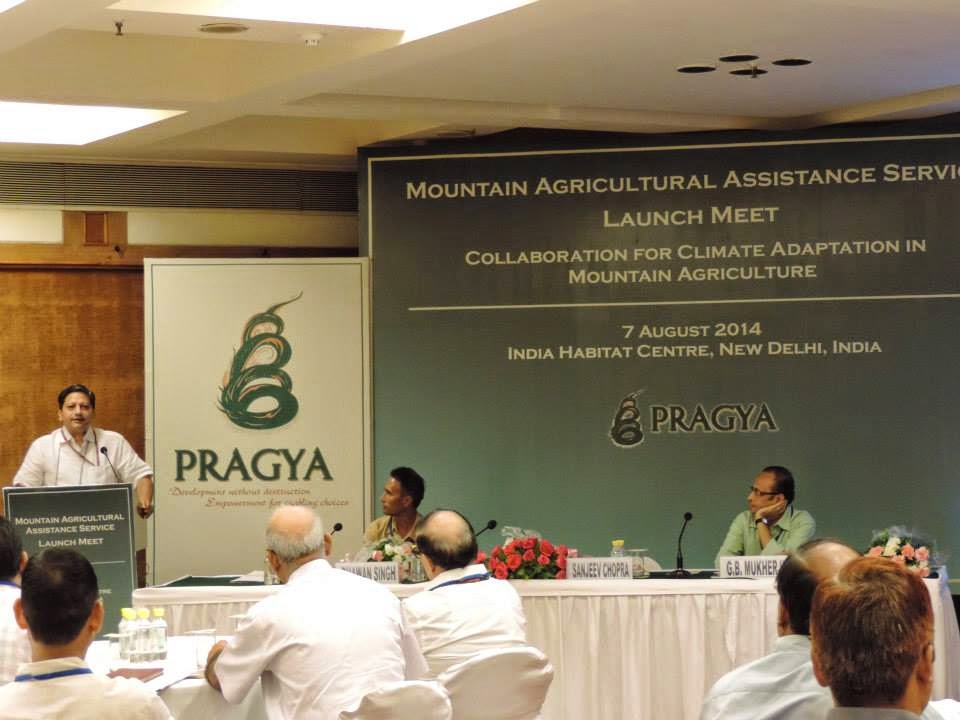
Mountain Agricultural Assistance Service Launch

Pragya organised a national workshop to initiate a multi- stakeholder network: Mountain Agricultural Assistance Service (MAAS). The event held on 7th August, 2014, at India Habitat Centre, New Delhi, India was inaugurated by Dr. Sanjeev Chopra, Jt. Secretary, Ministry of Agriculture – Govt. of India and had participation from national, regional and local institutions, government & non-governmental, as well as experts on mountain agriculture.

The workshop was designed to facilitate interaction among the participants to document the existing pool of knowledge and support services and draw out recommendations for functioning of the MAAS network and insights on key action options to address food security of the small farmers. 

The one-day event began with a brief inaugural session that highlighted the relevance of MAAS network in the current Himalayan context, which was followed by multi-stakeholder deliberations for two sessions: Working session 1: Pathways for Alliance and Working session2: Specific Interventions for Mountain Agriculture.

The process looked at the issues plaguing the mountain agriculture and posing threat to food security of the small farmers in the region and facilitated cross stakeholder understanding of the issues. The participative process also brought out recommendations for the network functions that are expected to be far closer to the stakeholder needs and area specific requirements.

The post-lunch session saw presentations by technical experts from NCPAH-Ministry of Agriculture, IMD Agro-met Division and SASE on existing support services and potential contributions towards Mountain Agricultural Assistance Service. The event concluded with sharing of results of the deliberations and summarization of the key priorities.

  When Old Patterns Stop Making Sense: Shifts in Western Himalayan Plant Assemblages, 2020-2024 by Sudipto Majumdar, Pragya T...