Showing posts with label Himalayas. Show all posts

10 April 2018

And this time it is Strawberries in the poly houses of Nepal

Maya Tamang a 40 years old woman lives in Gamailo and was selected as one of the farmers for poly house beneficiaries in Nuwakot district of Kakani Gaupalika. Maya has a family of 7 members and has 2 children. Being illiterate, Maya Tamang did not have enough alternatives for livelihood which made her a potential beneficiary and work as a farmer for poly house in Nuwakot District of Kakani Gaupalika.

Looking at the development indicators of life of villagers, Pragya implemented the project called “Improving Rural Livelihoods, Water & Sanitation in Earthquake Damaged Areas of Nepal” where a holistic rehabilitation programme is being delivered in Nepal. Current interventions are aimed at addressing critical needs of poor households affected by the earthquake in four disaster-affected districts in Nepal. The interventions are focussed on water and sanitation, short-term income generation, long-term livelihood development and protection of women from gender-based violence.

Selected as one of the livelihood package beneficiaries under the project, Maya decided to take this opportunity in the hope of providing better support to her family. Under the project staff’s supervision, she adopted poly house for strawberry production. After receiving support for the polyhouse like silpaulin sheet and bamboo, she zealously spent her time on the construction of poly house. Furthermore, the number of training she received from other organization during the previous year helped her to implement the technology, appropriately.

Maya Tamang in her polyhouse where she has planted strawberry
The variety of strawberries cultivated in Nepal requires an altitude of 1500 - 2500m with a temperature range of 4 - 25 degree Celsius and 3000 - 4000 ml of rainfall, making Kakani the ideal location for such cultivation. The preparation for strawberry cultivation begins around the month of June. After the months of tending, the actual plantation is carried out during September and the produce is ready by November.

Before planting strawberry in poly house, Maya Tamang used to cultivate maize in her farmland. During that time the income she incurred was very less which was not sufficient for her family. But after the strawberry cultivation in the poly house, she is able to have a good yield. In Maya’s words, it was not only her effort alone, her family members have also contributed equally to the cultivation of the strawberries. They helped in watering the plants and put fertilizers and nutrients regularly in the soil. Maya has already sold about 100 kg of strawberry this season and earns 30,000 INR and is still selling the strawberries. Her target is to achieve an income of 1, 50,000 INR. She is happy and satisfied with what she has gained and wants to work harder to make more money from the strawberry fields.

Strawberry in Maya Tamang's polyhouse
“We have seen difficult times when we did not have money to pay for children’s school books for school. Now life has become easier as we are able to manage our daily expenses smoothly,” says Maya Tamang.


Together, Maya and her family have planned to save half of their income for their children’s education and invest the other half to buy food grains that will keep them secure for the entire year. She wants to bring women in the community together, who are interested in strawberry farming along with her and are willing to develop micro-entrepreneurs so that the women in that area do not have to migrate to other places in search of work which will also help in stopping human trafficking in this area.

4 January 2018

Weather Monitoring Installations: Helping Himalayan villages prepare better...


Jagat Ram, a 40 years old Gram Pradhan of Durlekh panchayat of Didihat block, Pithoragarh narrates that cloudbursts and landslides are the main hazards in his Gram Panchayat and how on 15 Aug 2004, a landslide destroyed his house, killed a girl in his village, shattering many lives in front of his eyes.

31-year-old Pushpa Devi of Munsiyari block, Pithoragarh also shares that the villages in her Panchayat are highly exposed to landslides caused by heavy rainfalls and floods. She says, ”In both 2008 and 2013, many households and cattle were washed away by landslides in Bhadeli village.”


Jagat Ram can be seen here
Like Jagat Ram and Pushpa Devi, a majority of the villagers in these Himalayan districts are farmers and their livelihood is directly linked to vagaries of weather conditions. On learning about the Pragya’s installations of weather monitoring stations in the number of villages, they appear hopeful that there would be less damage in such events now, as people could be alarmed beforehand. Pushpa Devi says, “It will not only warn us about the hazardous event but will also help us in getting adequate emergency supplies, in place, post-disaster.” 


Installation of weather monitoring stations is being piloted across 800 villages in 4 districts (Chamoli, Pithoragarh, Rudraprayag, and Uttarkashi) under the project DMS Himalaya by Pragya. The project incorporates two tools namely “Go-Risk” which is an early warning tool with grassroots measurement grids and communication channels for pre-disaster use) and “RnR-Comm”, a component for relief and response information-sharing tool to help multi-agency response coordination for post-disaster use. These tools aim to enhance local self-reliance and improve the effectiveness of humanitarian support.


DMS Himalaya focusses on pre-disaster early warning system by strengthening the communities to be aware of early warnings through regular monitoring of weather conditions which can prevent loss of lives and damage to resources and livestock even if the disaster strikes. The young and enthusiastic local villagers are identified and trained to form Disaster Response Team (DRTs) to use these stations independently by conducting mapping, monitoring, and reporting on damage and relief, post-disaster. The identified Points of Presence (POPs), function as communication centers for isolated habitations in remote parts.  The initiative is further strengthened by forming resource hubs District Disaster Management Support Units (DDMSUs), for implementing DMS Himalayas effectively.

Weather monitor installed in  one of the clusters in Ukimath
“As far as I know this is first of its kind project. This will forewarn us about the disasters, and will save many lives” says Balwant Singh, a resident of Sitoli village of Didihat block in Pithoragarh, Uttarakhand.

These weather stations are gradually enabling the villagers in the Himalayan districts to prepare themselves for forthcoming calamities and helping them to build a disaster-resilient future for themselves! 


18 July 2017

Earthquake-hit farmers in Nepal rest hope on polyhouses

In 2015, when the 7.8-Magnitude earthquake in Nepal caused extensive damage to infrastructure and livelihoods of its people, many had lost hope that their lives would ever return to normal. Tek Bahadur, a 60-year-old farmer residing in Kubinde Tol village of Sindhupalchok district, was one of them. His son was killed in a bus accident more than five years ago and the only source of income for him was half-an-acre piece of agricultural land that fetched him an annual income of US $450.

Tek Bahadur can be seen working in his polyhouse 
On the morning of April 25, 2015, one of the worst temblors in 80 years for Nepal completely destroyed Bahadur’s house and left the already Below Poverty Line farmer destitute and in need of dire help. The following year, Bahadur came to know that Pragya was initiating the construction of poly houses to enable production of off-season vegetables for the households, under its Rebuilding Rural Nepal program. “For a farmer like me who had lost everything, a proposal to construct a polyhouse in his own land has brought a glimmer of hope,” says Bahadur. He was then encouraged to attend trainings that will impart  technical skills and knowledge to take forward the polyhouses that would be set up by Pragya.

Today, Bahadur treats the set up as his own physical asset for an increased livelihood and is trying his hand at growing both seasonal and off-seasonal vegetables. He and fellow beneficiaries have gained profits by selling the produce in nearby markets.


“Tomatoes, and more tomatoes in my field”

A polyhouse set up in Majhi's field
Kamala Majhi, a 35-year old female farmer in Sindhupalchowk, was another victim left empty handed by the earthquake. “Our house got damaged and utensils were found within the rubbles and we lost all means to make money,” says Majhi who was also a beneficiary of Pragya’s initiative to construct polyhouses in 100 plots, after stringent site and beneficiary assessment for selecting the most needy households.

Majhi has a polyhouse constructed in a rented piece of land where she has sowed some tomato seeds. “I am convinced that tomatoes will have higher yield than other vegetables and I know I will have many tomatoes to sell in the market,” says the farmer.


22 September 2014

Pragya joins The People's Climate March


The People's Climate March was one of the largest activist event in recent years to advocate global action against climate change that took place on Sunday, September 21, 2014, in New York City, USA. Pragya's Research & Advocacy and Communication & Engagement team members joined the Climate March held in New Delhi, India, Saturday, September 20, 2014, anchored by 350.org India. They joined thousands of college students, children, civil society representatives, and members of communities affected by disaster/climate change. The team carried its banner raising concerns regarding the frequent high impact natural disasters in the Himalayas and were at the forefront of the procession from Mandi House to Jantar Mantar. (More info)

8 August 2014

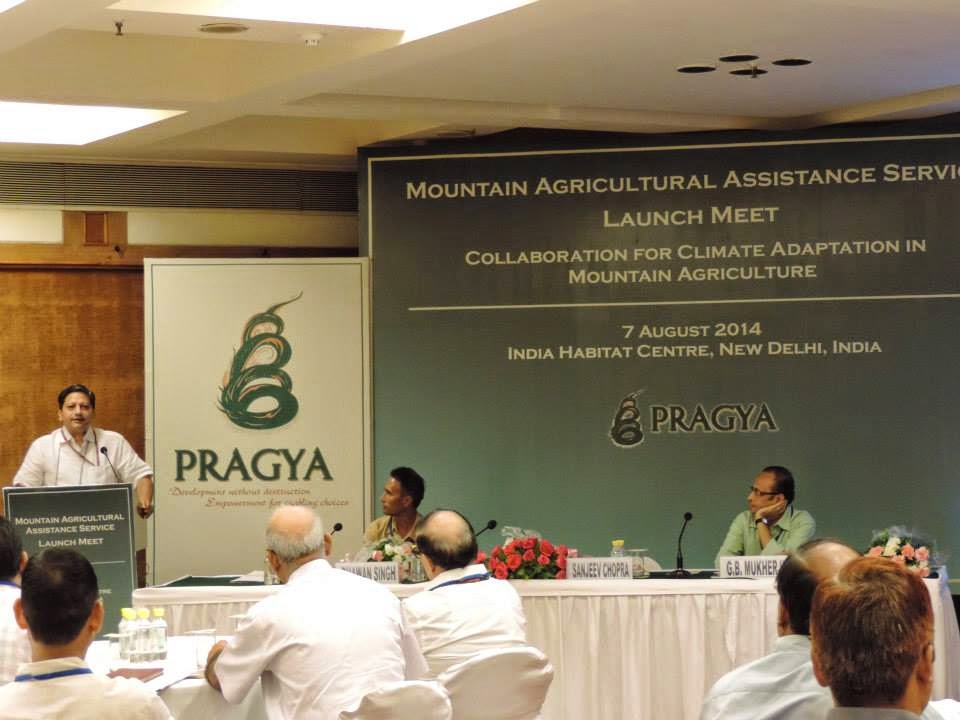
Mountain Agricultural Assistance Service Launch

Pragya organised a national workshop to initiate a multi- stakeholder network: Mountain Agricultural Assistance Service (MAAS). The event held on 7th August, 2014, at India Habitat Centre, New Delhi, India was inaugurated by Dr. Sanjeev Chopra, Jt. Secretary, Ministry of Agriculture – Govt. of India and had participation from national, regional and local institutions, government & non-governmental, as well as experts on mountain agriculture.

The workshop was designed to facilitate interaction among the participants to document the existing pool of knowledge and support services and draw out recommendations for functioning of the MAAS network and insights on key action options to address food security of the small farmers. 

The one-day event began with a brief inaugural session that highlighted the relevance of MAAS network in the current Himalayan context, which was followed by multi-stakeholder deliberations for two sessions: Working session 1: Pathways for Alliance and Working session2: Specific Interventions for Mountain Agriculture.

The process looked at the issues plaguing the mountain agriculture and posing threat to food security of the small farmers in the region and facilitated cross stakeholder understanding of the issues. The participative process also brought out recommendations for the network functions that are expected to be far closer to the stakeholder needs and area specific requirements.

The post-lunch session saw presentations by technical experts from NCPAH-Ministry of Agriculture, IMD Agro-met Division and SASE on existing support services and potential contributions towards Mountain Agricultural Assistance Service. The event concluded with sharing of results of the deliberations and summarization of the key priorities.

  When Old Patterns Stop Making Sense: Shifts in Western Himalayan Plant Assemblages, 2020-2024 by Sudipto Majumdar, Pragya T...