Showing posts with label women. Show all posts

10 April 2018

And this time it is Strawberries in the poly houses of Nepal

Maya Tamang a 40 years old woman lives in Gamailo and was selected as one of the farmers for poly house beneficiaries in Nuwakot district of Kakani Gaupalika. Maya has a family of 7 members and has 2 children. Being illiterate, Maya Tamang did not have enough alternatives for livelihood which made her a potential beneficiary and work as a farmer for poly house in Nuwakot District of Kakani Gaupalika.

Looking at the development indicators of life of villagers, Pragya implemented the project called “Improving Rural Livelihoods, Water & Sanitation in Earthquake Damaged Areas of Nepal” where a holistic rehabilitation programme is being delivered in Nepal. Current interventions are aimed at addressing critical needs of poor households affected by the earthquake in four disaster-affected districts in Nepal. The interventions are focussed on water and sanitation, short-term income generation, long-term livelihood development and protection of women from gender-based violence.

Selected as one of the livelihood package beneficiaries under the project, Maya decided to take this opportunity in the hope of providing better support to her family. Under the project staff’s supervision, she adopted poly house for strawberry production. After receiving support for the polyhouse like silpaulin sheet and bamboo, she zealously spent her time on the construction of poly house. Furthermore, the number of training she received from other organization during the previous year helped her to implement the technology, appropriately.

Maya Tamang in her polyhouse where she has planted strawberry
The variety of strawberries cultivated in Nepal requires an altitude of 1500 - 2500m with a temperature range of 4 - 25 degree Celsius and 3000 - 4000 ml of rainfall, making Kakani the ideal location for such cultivation. The preparation for strawberry cultivation begins around the month of June. After the months of tending, the actual plantation is carried out during September and the produce is ready by November.

Before planting strawberry in poly house, Maya Tamang used to cultivate maize in her farmland. During that time the income she incurred was very less which was not sufficient for her family. But after the strawberry cultivation in the poly house, she is able to have a good yield. In Maya’s words, it was not only her effort alone, her family members have also contributed equally to the cultivation of the strawberries. They helped in watering the plants and put fertilizers and nutrients regularly in the soil. Maya has already sold about 100 kg of strawberry this season and earns 30,000 INR and is still selling the strawberries. Her target is to achieve an income of 1, 50,000 INR. She is happy and satisfied with what she has gained and wants to work harder to make more money from the strawberry fields.

Strawberry in Maya Tamang's polyhouse
“We have seen difficult times when we did not have money to pay for children’s school books for school. Now life has become easier as we are able to manage our daily expenses smoothly,” says Maya Tamang.


Together, Maya and her family have planned to save half of their income for their children’s education and invest the other half to buy food grains that will keep them secure for the entire year. She wants to bring women in the community together, who are interested in strawberry farming along with her and are willing to develop micro-entrepreneurs so that the women in that area do not have to migrate to other places in search of work which will also help in stopping human trafficking in this area.

5 July 2016

Empowering the Hinterlands - An Update


In ancient times, a scapegoat was an animal on whose back the sins of a community were placed, and was cast out in the desert, which is where the term scapegoating comes from. One of the forms in which this practice continues to live, is witch hunting, still prevalent in parts of India today. In the hinterlands of the country, it is convenient for the community to transfer its misfortunes on those already at the margins: widows, unmarried or old women.

According to the most recent report of the National Crime Records Bureau (NCRB, 2014), out of the 156 murder cases relating to ‘witchcraft’ reported in the country, 47 were from Jharkhand.  The report does not include cases of violence not resulting in murder or the social death that the victims accused of witchcraft suffer. Witch-hunting is mainly used as a pretext for rape or grabbing property, but sometimes illness or sudden death of people or livestock can also trigger the anger of the community.


Speaking at the inauguration of the Pragya Sashaktikaran Kendra – Empowerment Centre (EC) – in Ranchi, Dr Mahua Manji, Chairperson of Jharkhand State Women’s Commission, said, “witch-hunting mainly occurs due to health issues in the community”.

In the rural areas of Jharkhand and other states, people rely heavily on Ojhas, or spiritual healers or exorcists, in spite of the presence of Primary Healthcare Centres. A lack of understanding of basic health issues and formal healthcare contributes to high mortality rate from diseases, and the Ojhas, with no formal training in medicine, are often the ones to brand and therefore instigate the violence against the ‘witches’.

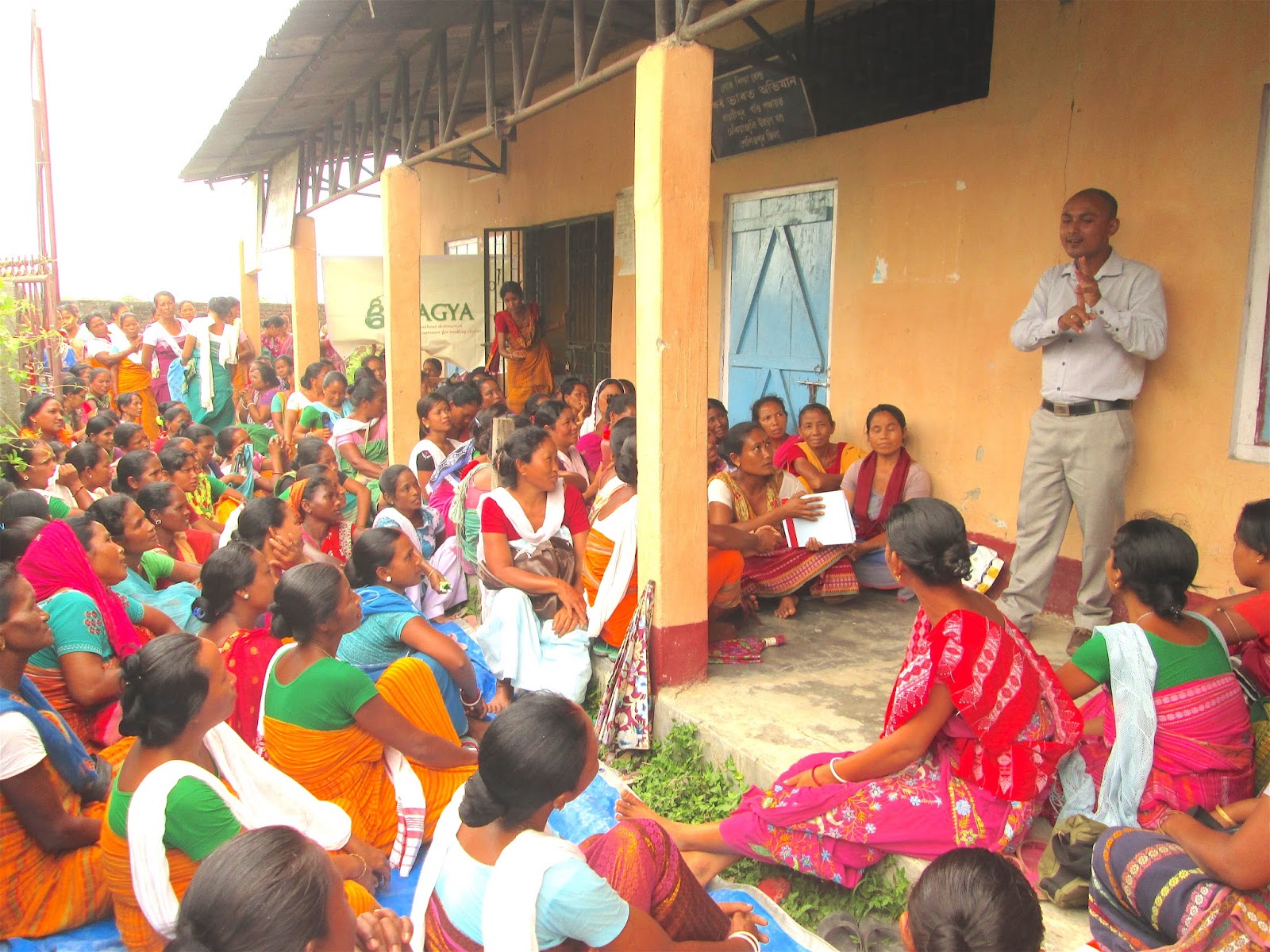
Punam Toppo, a social activist who has been campaigning to prevent Violence Against Women (VAW) for more than a decade, has felt the effect of this violence first hand. Her grandmother, under whose care she grew up after her parents passed away, was accused of being a witch; the family was designated a social outcast and was forced to move out of the village. Ms. Toppo is associated with the Association for Social and Human Awareness (ASHA), which works for the empowerment of women in the grassroots. Pragya has partnered with ASHA in Jharkhand, and together we have formed Women’s Peer Groups (WPGs) in 10 villages in Ranchi district, raising awareness about the basic issues of health, nutrition and women’s rights.


Pragya has also established an Empowerment Centre in Tezpur in Soniptur district of Assam. The state, which passed legislation against witch hunting in 2015, has been in the news for the high prevalence of witch hunting practices. Our project in Sonitpur covers a total of 10 villages in the Dekhiajuli and Chariduari blocks. The formation of the WPG in Batachipur village saw the participation of upwards of 100 women. We received an enthusiastic response from Ghargra Kachari, Gormara Kachari, and Shantipur villages in Dekhiajuli block and Bogijuli village in Chariduari block.


Pragya has expanded its presence to Jharkhand and Assam with the establishing of these ECs and will be moving to include Bihar shortly. This is part of a joint project with the UN Trust Fund to End Violence Against Women (UNTF), and will cover ten districts in five states of Assam, Bihar, Jharkhand, Himachal Pradesh and Rajasthan.

3 June 2016

Improving maternal and child health in Kenya


The Laikipia, Samburu and Turkana counties are underdeveloped semi-arid and arid lands in Northern Kenya. The frequent cross-border attacks and raids on livestock by armed tribesmen in the region leads to a high number of casualties and a stunting of development programmes among the pastoralist communities in the region; there is limited access to basic welfare services, most of which have been destroyed in the prolonged conflict. This also has an adverse effect on the health of the women and children.

In recent years, Kenya has performed poorly on indicators of Maternal, Newborn and Child Health (MNCH); the 2014 Kenyan demographic survey shows that infant mortality rate in the country stood at 39 deaths per 1000 births, and the World Bank survey assessed Maternal Mortality Rate (MMR) at 525 for the same year. The widespread HIV infection and the prevalence of practices such as Female Genital Mutilation (FGM) and beading  (community sanctioned rape by a relative) also have an adverse impact on the health of women in the region.

Pragya’s intervention is focusing on the MNCH levels in the area. We are conducting research and holding consultations with local community members to generate qualitative data on the state of existing welfare services, reproductive health & nutrition among women and the potential challenges to establishing peer support networks in the region. The data collected after interacting with the locals, and other participants will be validated at the village and country level. The findings of the study will be collated, analyzed and published in the form of a report.


The dissemination of the findings from the research will aim to strengthen the local healthcare capacity, increase access to maternal and child health services in the community and improve the local healthcare governance in the region.

15 April 2016

Pragya's Sashaktikaran Kendra to empower the tribal hinterlands of Rajasthan


Pragya, an NGO based in Gurgaon (Haryana), is implementing a 3-year project aimed at empowering the tribal communities in the states of Himachal Pradesh, Rajasthan, Bihar, Jharkhand and Assam. The project aims to reach out to the rural population in 10 districts (2 districts in each state) and extend to these improved accesses to relevant services and provisions.

In Rajasthan, Pragya is working towards empowering the tribal communities in the districts of Dungarpur and Udaipur. As part of its efforts, an Information Center (IC) called Pragya Sashaktikaran Kendra would be set up in each of the two districts. The very first Pragya Sashaktikaran Kendra will be formally launched in Dungarpur. It would play a vital multi-faceted role in the empowerment of the tribal communities in the area. It would conduct trainings and awareness sessions and function as an information hub on legislations & schemes initiated by Union/State governments pertaining to health, nutrition, livelihoods, with a particular focus on STs and women. It would also operate a Helpline to address queries of community members on these issues and provide referral services by routing aid seekers towards relevant professionals like health service providers, technical experts, social workers, lawyers, CBOs. Center staff will also maintain a ‘development observatory’ on infrastructural lacunae, gaps in services, with special focus on health & nutrition and gender issues, in order to communicate community needs to concerned authorities. Pragya envisages that the activities of the Center would bring about reduced drudgery, violence and marginalization faced by the women as well as improved dietary intake and nutrition levels and health care for all members of tribal communities in the area; concurrently, there would be improved skill levels and diversified livelihood options for these communities.

Pragya was set up with a concern for last-mile communities neglected and marginalized in the development process. They have been carrying out programs in the areas of education, health, conservation and livelihoods for the benefit of vulnerable communities for over 20 years and have addressed the development needs of communities in the most remote and least developed regions in the country through their work.

The first Pragya Sashaktikaran Kendra will be formally launched in Dungarpur, Rajasthan in the month of April 2016.
  

10 November 2014

Reaching out to people in flood hit Jammu & Kashmir

Pragya is currently working to respond to the needs of the affected people in the Himalayan state of Jammu & Kashmir that has been devastated by one of the worst floods in 103 years. With our field officers coordinating efforts from Srinagar and Jammu, Pragya is reaching out to flood-victims in Jammu, Reasi, Kulgam, Srinagar, Pulwama, Budgam, Anantnag, Baramulla and Bandipora districts, which are among the worst affected. (View map)


Our sincere thanks to Aarti Drugs Ltd., Agility India Pvt. Ltd., Amdocs Information Security, BP Foundation , Chambal Fertilisers & Chemicals Ltd, Crompton Greaves Ltd, Godfrey Phillips India, Happy World, Hitachi India Pvt. Ltd., Indian Cultural Exchange - Emory University, Atlanta, Georgia, USA, InterGlobe Aviation Ltd-IndiGo, Jet Airways (India) Ltd, Paul Wurth India, Perfetti Van Melle India Pvt. Ltd, SpiceJet Ltd, Vestige Marketing Pvt. Ltd., Young Managers Forum - JK Lakshmi Cement ltd. and all individual supporters who have helped us reach out to those in need. 

Thanks to our supporters, we have reached 9954 items of hygiene kits, 282 packs of baby food, 914 nutrition-packs for children, 102 medicine kits and bulk quantities during health camps, 13332 kg food grains and spices, and 330 ltr of cooking oil,8287 packs of ready-to-eat food items, 1949 blankets, 160 sets of utensils/emergency lights, 2148 ltr water and 22040 water purifying tablets, 914 warm wear kits for children, so far. Current efforts are focused on addressing needs for warm wear before winter sets in. (Read more about our outreach)

To join our efforts, please write to: research@pragya.org or call +91 9810188066.
(More information)

8 August 2014

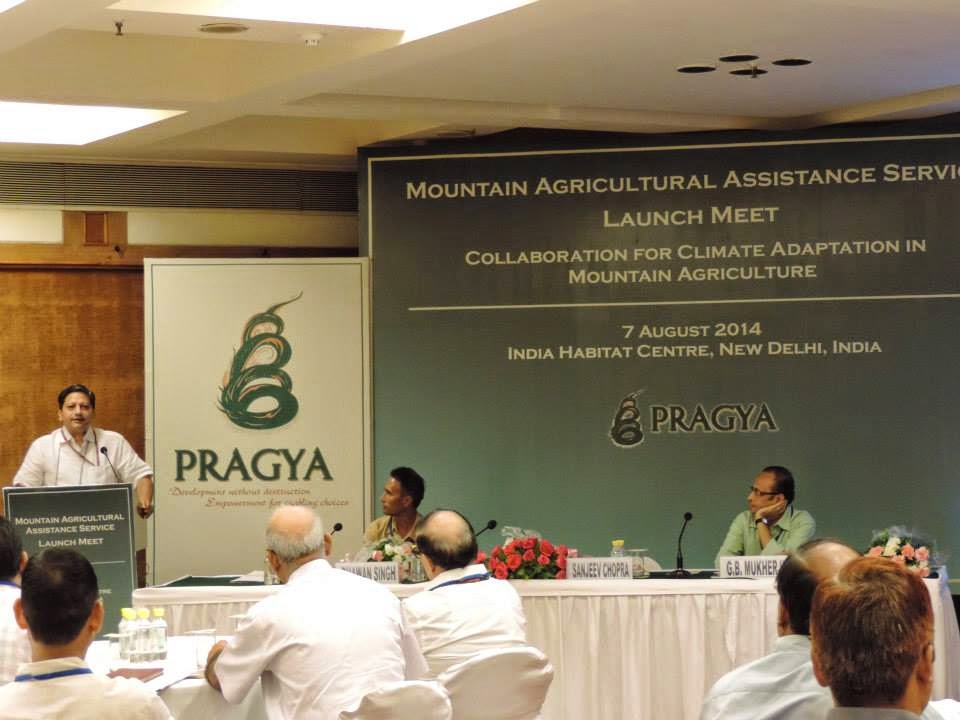
Mountain Agricultural Assistance Service Launch

Pragya organised a national workshop to initiate a multi- stakeholder network: Mountain Agricultural Assistance Service (MAAS). The event held on 7th August, 2014, at India Habitat Centre, New Delhi, India was inaugurated by Dr. Sanjeev Chopra, Jt. Secretary, Ministry of Agriculture – Govt. of India and had participation from national, regional and local institutions, government & non-governmental, as well as experts on mountain agriculture.

The workshop was designed to facilitate interaction among the participants to document the existing pool of knowledge and support services and draw out recommendations for functioning of the MAAS network and insights on key action options to address food security of the small farmers. 

The one-day event began with a brief inaugural session that highlighted the relevance of MAAS network in the current Himalayan context, which was followed by multi-stakeholder deliberations for two sessions: Working session 1: Pathways for Alliance and Working session2: Specific Interventions for Mountain Agriculture.

The process looked at the issues plaguing the mountain agriculture and posing threat to food security of the small farmers in the region and facilitated cross stakeholder understanding of the issues. The participative process also brought out recommendations for the network functions that are expected to be far closer to the stakeholder needs and area specific requirements.

The post-lunch session saw presentations by technical experts from NCPAH-Ministry of Agriculture, IMD Agro-met Division and SASE on existing support services and potential contributions towards Mountain Agricultural Assistance Service. The event concluded with sharing of results of the deliberations and summarization of the key priorities.

  When Old Patterns Stop Making Sense: Shifts in Western Himalayan Plant Assemblages, 2020-2024 by Sudipto Majumdar, Pragya T...