Showing posts with label Gender Based Violence. Show all posts

10 April 2018

And this time it is Strawberries in the poly houses of Nepal

Maya Tamang a 40 years old woman lives in Gamailo and was selected as one of the farmers for poly house beneficiaries in Nuwakot district of Kakani Gaupalika. Maya has a family of 7 members and has 2 children. Being illiterate, Maya Tamang did not have enough alternatives for livelihood which made her a potential beneficiary and work as a farmer for poly house in Nuwakot District of Kakani Gaupalika.

Looking at the development indicators of life of villagers, Pragya implemented the project called “Improving Rural Livelihoods, Water & Sanitation in Earthquake Damaged Areas of Nepal” where a holistic rehabilitation programme is being delivered in Nepal. Current interventions are aimed at addressing critical needs of poor households affected by the earthquake in four disaster-affected districts in Nepal. The interventions are focussed on water and sanitation, short-term income generation, long-term livelihood development and protection of women from gender-based violence.

Selected as one of the livelihood package beneficiaries under the project, Maya decided to take this opportunity in the hope of providing better support to her family. Under the project staff’s supervision, she adopted poly house for strawberry production. After receiving support for the polyhouse like silpaulin sheet and bamboo, she zealously spent her time on the construction of poly house. Furthermore, the number of training she received from other organization during the previous year helped her to implement the technology, appropriately.

Maya Tamang in her polyhouse where she has planted strawberry
The variety of strawberries cultivated in Nepal requires an altitude of 1500 - 2500m with a temperature range of 4 - 25 degree Celsius and 3000 - 4000 ml of rainfall, making Kakani the ideal location for such cultivation. The preparation for strawberry cultivation begins around the month of June. After the months of tending, the actual plantation is carried out during September and the produce is ready by November.

Before planting strawberry in poly house, Maya Tamang used to cultivate maize in her farmland. During that time the income she incurred was very less which was not sufficient for her family. But after the strawberry cultivation in the poly house, she is able to have a good yield. In Maya’s words, it was not only her effort alone, her family members have also contributed equally to the cultivation of the strawberries. They helped in watering the plants and put fertilizers and nutrients regularly in the soil. Maya has already sold about 100 kg of strawberry this season and earns 30,000 INR and is still selling the strawberries. Her target is to achieve an income of 1, 50,000 INR. She is happy and satisfied with what she has gained and wants to work harder to make more money from the strawberry fields.

Strawberry in Maya Tamang's polyhouse
“We have seen difficult times when we did not have money to pay for children’s school books for school. Now life has become easier as we are able to manage our daily expenses smoothly,” says Maya Tamang.


Together, Maya and her family have planned to save half of their income for their children’s education and invest the other half to buy food grains that will keep them secure for the entire year. She wants to bring women in the community together, who are interested in strawberry farming along with her and are willing to develop micro-entrepreneurs so that the women in that area do not have to migrate to other places in search of work which will also help in stopping human trafficking in this area.

19 March 2018

Gaining their voices to say "No more violence!” through Know Your Rights Campaign

On International Women’s Day, Pragya in India mobilised communities in five districts across three states in the first phase of its biannual ‘Know Your Rights’ campaign under the project 'Comprehensive primary prevention programme addressing violence against ethnic minority women in India’ focussed on the community-led interventions to address violence both within family or private sphere and violence that occurs in the community or public sphere. The project is currently running in the states of Rajasthan, Assam, Bihar, Jharkhand and Himachal Pradesh, with a special focus on the tribal population. In order to create safer and enabling environment for women and girls, Women Peer Group (WPG) leaders across 5 states are actively engaging the community members to provide guidance on health, nutrition, rights, and issues related to violence against women and girls (VAWG) and empower girls by taking collective actions to prevent VAWG in the target communities.

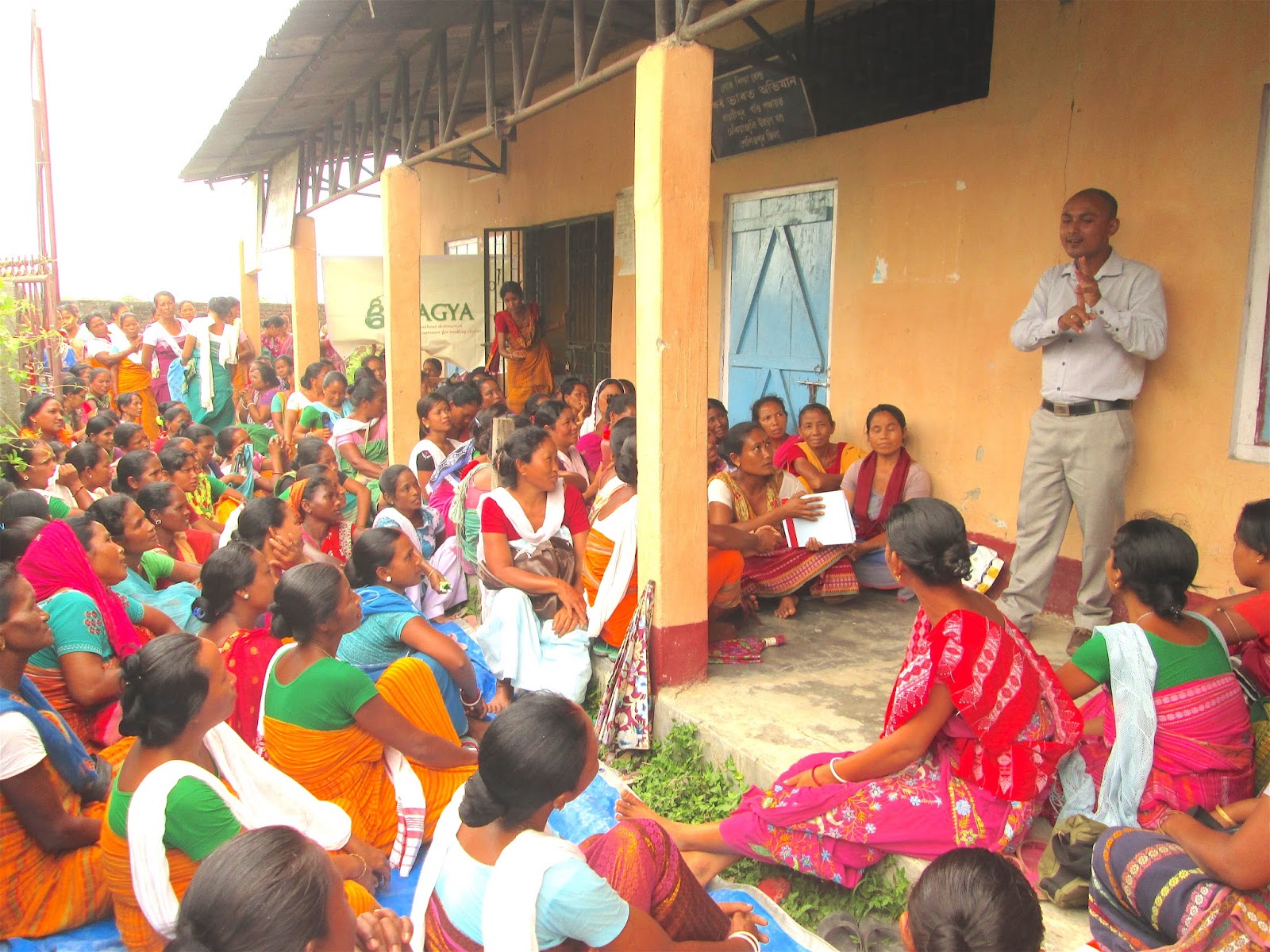
Women participate in KYR campaign in Lakhimpur, Assam
These WPG leaders, the anchors of the project conducted the KYR campaign by organizing an interactive street-play called “Ramli kyu maar khaye?” portraying one day in the life of a rural woman fictionally called Ramli, who faces domestic violence and how others in the village like mukhiya, Women Peer Group leaders and neighbours around her come forward to combat the violence done to Ramli and positively influence her husband (fictional name Devilal) to say no to violence by informing him about the adverse effects of violence on women and the existing laws that women can use to exercise their rights.  The audience applauded the performance of Pragya volunteers and had a lively discussion with the staff on countering violence against women.

The rallies conducted had the participation of both community members and school students. The posters which were developed for the campaign highlighted the issue of domestic violence, education of and celebrating the girl child. The message through these activities emphasized that as responsible citizens, we should not remain as mute spectators when we see any form of violence in our neighborhood and to deal with every act of violence in a collective and concerted manner. Around 731 people participated actively in the street play on domestic violence and the rally along with an extended outreach of over +1500 observers of the rally.
School children in Chamba participate in the rally


The campaign also employed stimulating media like SMSs in vernacular focussing on the messages related to eliminating violence and women and educating girl child. These messages reached out to over 10,000 people in the target districts. The campaign also underlined the need to ensure safe domestic spaces and recognize that domestic violence exists around all of us and there is a need to come together to uproot this evil practice which enabled a platform to villagers to voice out their concerns and emerging needs related to construction of toilets for girls in the government schools, safety of girls and domestic violence. The stakeholders also informed the villagers on various mechanisms and bodies functioning at the village and panchayat level to help and guide aggrieved women on violence-related cases and ease out the legal process.

The event saw a magnificent turnout from the local communities who were moved by the essence and spirit of the message, “Har vyakti ka hain yahi kehna, hinsa ko ab nahi hain sehna!” (Every person says, we won’t tolerate violence!). In some of the locations, like Sonitpur and Lakhimpur, people also traveled from different villages to the location of the campaign, sharing the need to have such campaigns in their villages for sensitization on the issue of domestic violence.
Our campaign event covered in Dainik Bhaskar, Rajasthan


The Know Your Rights campaign was also covered by the local vernacular newspapers in all the three states. The Know Your Rights campaign would continue for the next 2 months where Pragya will continue engaging the communities to create safer and healthier spaces for women and girls. 

5 July 2016

Empowering the Hinterlands - An Update


In ancient times, a scapegoat was an animal on whose back the sins of a community were placed, and was cast out in the desert, which is where the term scapegoating comes from. One of the forms in which this practice continues to live, is witch hunting, still prevalent in parts of India today. In the hinterlands of the country, it is convenient for the community to transfer its misfortunes on those already at the margins: widows, unmarried or old women.

According to the most recent report of the National Crime Records Bureau (NCRB, 2014), out of the 156 murder cases relating to ‘witchcraft’ reported in the country, 47 were from Jharkhand.  The report does not include cases of violence not resulting in murder or the social death that the victims accused of witchcraft suffer. Witch-hunting is mainly used as a pretext for rape or grabbing property, but sometimes illness or sudden death of people or livestock can also trigger the anger of the community.


Speaking at the inauguration of the Pragya Sashaktikaran Kendra – Empowerment Centre (EC) – in Ranchi, Dr Mahua Manji, Chairperson of Jharkhand State Women’s Commission, said, “witch-hunting mainly occurs due to health issues in the community”.

In the rural areas of Jharkhand and other states, people rely heavily on Ojhas, or spiritual healers or exorcists, in spite of the presence of Primary Healthcare Centres. A lack of understanding of basic health issues and formal healthcare contributes to high mortality rate from diseases, and the Ojhas, with no formal training in medicine, are often the ones to brand and therefore instigate the violence against the ‘witches’.

Punam Toppo, a social activist who has been campaigning to prevent Violence Against Women (VAW) for more than a decade, has felt the effect of this violence first hand. Her grandmother, under whose care she grew up after her parents passed away, was accused of being a witch; the family was designated a social outcast and was forced to move out of the village. Ms. Toppo is associated with the Association for Social and Human Awareness (ASHA), which works for the empowerment of women in the grassroots. Pragya has partnered with ASHA in Jharkhand, and together we have formed Women’s Peer Groups (WPGs) in 10 villages in Ranchi district, raising awareness about the basic issues of health, nutrition and women’s rights.


Pragya has also established an Empowerment Centre in Tezpur in Soniptur district of Assam. The state, which passed legislation against witch hunting in 2015, has been in the news for the high prevalence of witch hunting practices. Our project in Sonitpur covers a total of 10 villages in the Dekhiajuli and Chariduari blocks. The formation of the WPG in Batachipur village saw the participation of upwards of 100 women. We received an enthusiastic response from Ghargra Kachari, Gormara Kachari, and Shantipur villages in Dekhiajuli block and Bogijuli village in Chariduari block.


Pragya has expanded its presence to Jharkhand and Assam with the establishing of these ECs and will be moving to include Bihar shortly. This is part of a joint project with the UN Trust Fund to End Violence Against Women (UNTF), and will cover ten districts in five states of Assam, Bihar, Jharkhand, Himachal Pradesh and Rajasthan.

  When Old Patterns Stop Making Sense: Shifts in Western Himalayan Plant Assemblages, 2020-2024 by Sudipto Majumdar, Pragya T...