Showing posts with label technology. Show all posts

6 December 2014

Solar Wind Hybrid - embracing renewables for rural energy solution

Pragya has set up its third ‎Solar ‎Wind Hybrid System (‎SWHS) in Shyaso village, Kinnaur, Himachal Pradesh, as part of its efforts to enhance energy access in the Indian ‎Himalayas to improve quality of life in rural households. (View Photographs from the installation process) 

The jubilant Shyaso villagers inaugurated the facility in presence of the Block Development Officer. The combination of solar and wind ‎energy would ensure continual generation of power in this high altitude village - day-and-night, summer-or-winter.

The SWHS technology is ideal for stand alone systems for remote rural settlements. This innovation had won The Energy Globe Award (2005) for the pilot in the neighbouring district of Lahaul & Spiti, Himachal Pradesh.

View an update on IUCN quarterly newsletter

10 September 2014

Addressing nutrition - the Pragya way...

Food insecurity, hunger and malnutrition continue to pose a major challenge for development, globally. The Himalayan belt, a particularly remote and backward region, where food production is constrained by the terrain and severe climatic conditions, and the problems are compounded due to weak infrastructure, displays the worst food insecurity and nutritional status, with maximum impacts on women. Pragya is addressing these concerns through three broad strategies: (i) Women’s nutri-gardens and Nutrition Watch: small agricultural initiatives for women to increase family food security and nutritional levels; (ii) Nutrient-dense montane farming: agricultural practices and technologies which address nutrient deficiencies; and (iii) Himalayan agri-production scale-up: agricultural improvements for improving land productivity and crop yields to enhance farm incomes.
In Kinnaur district in the western Himalayas, early detection of high iron deficiency (Hb 7.0) in a women’s group member, by the women’s care and ‘Hunger & Nutrition Watch’ processes, and appropriate and sustained dietary intake via growing of cabbage and spinach crops in Nutri-Gardens helped the woman farmer achieve acceptable Haemoglobin levels (Hb 11.0). Women's groups in Sikkim, Darjeeling as well have shown keen interest in managing their home gardens and poly-houses for year round production.


8 August 2014

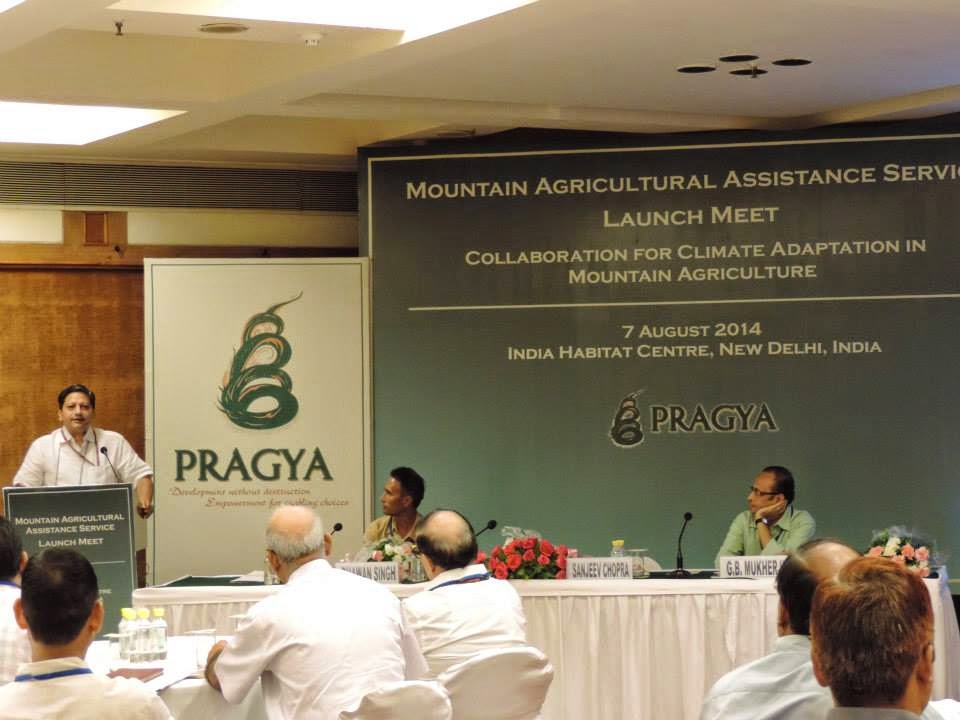
Mountain Agricultural Assistance Service Launch

Pragya organised a national workshop to initiate a multi- stakeholder network: Mountain Agricultural Assistance Service (MAAS). The event held on 7th August, 2014, at India Habitat Centre, New Delhi, India was inaugurated by Dr. Sanjeev Chopra, Jt. Secretary, Ministry of Agriculture – Govt. of India and had participation from national, regional and local institutions, government & non-governmental, as well as experts on mountain agriculture.

The workshop was designed to facilitate interaction among the participants to document the existing pool of knowledge and support services and draw out recommendations for functioning of the MAAS network and insights on key action options to address food security of the small farmers. 

The one-day event began with a brief inaugural session that highlighted the relevance of MAAS network in the current Himalayan context, which was followed by multi-stakeholder deliberations for two sessions: Working session 1: Pathways for Alliance and Working session2: Specific Interventions for Mountain Agriculture.

The process looked at the issues plaguing the mountain agriculture and posing threat to food security of the small farmers in the region and facilitated cross stakeholder understanding of the issues. The participative process also brought out recommendations for the network functions that are expected to be far closer to the stakeholder needs and area specific requirements.

The post-lunch session saw presentations by technical experts from NCPAH-Ministry of Agriculture, IMD Agro-met Division and SASE on existing support services and potential contributions towards Mountain Agricultural Assistance Service. The event concluded with sharing of results of the deliberations and summarization of the key priorities.

16 June 2014

E-book published - DMS-HIMALAYA

In June 2013, high-intensity rain and cloudbursts in the Indian State of Uttarakhand in the Himalayas triggered a series of hydrologic and geologic disasters, including glacial lake outbursts, landslides and flash floods, affecting more than 2,036,000 people and leading to one of the worst catastrophes of the decade. 

One year on, as the country still grapples with the calamitous event and its aftermath, in DMS-Himalaya, Banerji, Ipe and Basu through first-hand observations, vividly recapture the cascading combination disaster that occurred and the event trajectory. The book also examines the response process to the disaster, what worked and what did not. The learnings, from pre-event stages to post-event response, are drawn out with consideration of the complex interlinked issues related to disaster response in remote locations with fragile ecologies, and have been woven into a fortified disaster management system for the Himalayas.

  When Old Patterns Stop Making Sense: Shifts in Western Himalayan Plant Assemblages, 2020-2024 by Sudipto Majumdar, Pragya T...