
30 November 2014
Medicinal plants cultivation in Himalayas - visit from Agarwal Foundation

10 November 2014
Reaching out to people in flood hit Jammu & Kashmir
Pragya is currently working to respond to the needs of the affected people in the Himalayan state of Jammu & Kashmir that has been devastated by one of the worst floods in 103 years. With our field officers coordinating efforts from Srinagar and Jammu, Pragya is reaching out to flood-victims in Jammu, Reasi, Kulgam, Srinagar, Pulwama, Budgam, Anantnag, Baramulla and Bandipora districts, which are among the worst affected. (View map)
 Our sincere thanks to Aarti Drugs Ltd., Agility India Pvt. Ltd., Amdocs Information Security, BP Foundation , Chambal Fertilisers & Chemicals Ltd, Crompton Greaves Ltd, Godfrey Phillips India, Happy World, Hitachi India Pvt. Ltd., Indian Cultural Exchange - Emory University, Atlanta, Georgia, USA, InterGlobe Aviation Ltd-IndiGo, Jet Airways (India) Ltd, Paul Wurth India, Perfetti Van Melle India Pvt. Ltd, SpiceJet Ltd, Vestige Marketing Pvt. Ltd., Young Managers Forum - JK Lakshmi Cement ltd. and all individual supporters who have helped us reach out to those in need.
Thanks to our supporters, we have reached 9954 items of hygiene kits, 282 packs of baby food, 914 nutrition-packs for children, 102 medicine kits and bulk quantities during health camps, 13332 kg food grains and spices, and 330 ltr of cooking oil,8287 packs of ready-to-eat food items, 1949 blankets, 160 sets of utensils/emergency lights, 2148 ltr water and 22040 water purifying tablets, 914 warm wear kits for children, so far. Current efforts are focused on addressing needs for warm wear before winter sets in. (Read more about our outreach)
Our sincere thanks to Aarti Drugs Ltd., Agility India Pvt. Ltd., Amdocs Information Security, BP Foundation , Chambal Fertilisers & Chemicals Ltd, Crompton Greaves Ltd, Godfrey Phillips India, Happy World, Hitachi India Pvt. Ltd., Indian Cultural Exchange - Emory University, Atlanta, Georgia, USA, InterGlobe Aviation Ltd-IndiGo, Jet Airways (India) Ltd, Paul Wurth India, Perfetti Van Melle India Pvt. Ltd, SpiceJet Ltd, Vestige Marketing Pvt. Ltd., Young Managers Forum - JK Lakshmi Cement ltd. and all individual supporters who have helped us reach out to those in need. Thanks to our supporters, we have reached 9954 items of hygiene kits, 282 packs of baby food, 914 nutrition-packs for children, 102 medicine kits and bulk quantities during health camps, 13332 kg food grains and spices, and 330 ltr of cooking oil,8287 packs of ready-to-eat food items, 1949 blankets, 160 sets of utensils/emergency lights, 2148 ltr water and 22040 water purifying tablets, 914 warm wear kits for children, so far. Current efforts are focused on addressing needs for warm wear before winter sets in. (Read more about our outreach)
To join our efforts, please write to: research@pragya.org or call +91 9810188066.
(More information)
(More information)
6 November 2014
DEISPI workshop for educationally backward districts in India
The multi-stakeholder consultative workshop on DEISPI (Dynamic Education Information System for Planning and Improvement) ~ An Education Management & Information System for Tribal, Border, Hilly, Forested (TBHF) Districts in India was held on 5th November 2014 at India Habitat Centre, New Delhi,India. The workshop was supported by USAID under the 'All Children Reading: A Grand Challenge for Development' initiative, and was conducted by Pragya India. The event shared the learnings from the successful piloting of DEISPI with stakeholders in other educationally backward TBHF districts across India, as well as at the national level, and facilitating its uptake and implementation. The event sought to draw together national, state and district level institutions, governmental and non-governmental, involved in education delivery, with particular focus on TBHF districts, as well as educationists concerned with education policy, research, teachers' training and curriculum development to fine-tune the EMIS.
 Along with the Guest of Honour, Prof. Peter Ronald deSouza (Senior Fellow - Centre for Study of Developing Societies, Board Member - NUEPA) and Distinguished Guest Dr. Huma Masood (National Programme Officer - Gender & Education, UNESCO), the workshop had participation from institutions involved in education delivery, with particular focus on TBHF districts as well as educationists concerned with education policy, research, teachers’ training and curriculum development. Participation was elicited from national and international institutions such as NUEPA, ACER, SSA Missions and State Education Departments, Ministry of Tribal Affairs and Institutions (SCERTs, SIEs, DIETs), District Education Departments and institutions hailing from TBHF districts. The event also provided the opportunity for key stakeholders from the 11 piloted districts, to share their experience and concerns in implementing DEISPI.
The participative process brought out the need for modification in DEISPI Tools / Process / Methods of data collection and dissemination in TBHF districts across the country. Recognising that all TBHF districts are not alike , the participants of the workshop were divided into 5 working groups: TBHF with positive socio-political status, Border/peripheral TBHF, TBHF with chronic poverty, TBHF near mainstream economy and TBHF with significant socio-cultural barriers. The Chairs presented the results of the deliberations at the end of the session. (Glimpses from the event)
22 September 2014
Pragya joins The People's Climate March

The People's Climate March was one of the largest activist event in recent years to advocate global action against climate change that took place on Sunday, September 21, 2014, in New York City, USA. Pragya's Research & Advocacy and Communication & Engagement team members joined the Climate March held in New Delhi, India, Saturday, September 20, 2014, anchored by 350.org India. They joined thousands of college students, children, civil society representatives, and members of communities affected by disaster/climate change. The team carried its banner raising concerns regarding the frequent high impact natural disasters in the Himalayas and were at the forefront of the procession from Mandi House to Jantar Mantar. (More info)
10 September 2014
Addressing nutrition - the Pragya way...
 Food insecurity, hunger and malnutrition continue to pose a major challenge for development, globally. The Himalayan belt, a particularly remote and backward region, where food production is constrained by the terrain and severe climatic conditions, and the problems are compounded due to weak infrastructure, displays the worst food insecurity and nutritional status, with maximum impacts on women. Pragya is addressing these concerns through three broad strategies: (i) Women’s nutri-gardens and Nutrition Watch: small agricultural initiatives for women to increase family food security and nutritional levels; (ii) Nutrient-dense montane farming: agricultural practices and technologies which address nutrient deficiencies; and (iii) Himalayan agri-production scale-up: agricultural improvements for improving land productivity and crop yields to enhance farm incomes.


8 August 2014
Mountain Agricultural Assistance Service Launch
Pragya organised a national workshop to initiate a multi- stakeholder network: Mountain Agricultural Assistance Service (MAAS). The event held on 7th August, 2014, at India Habitat Centre, New Delhi, India was inaugurated by Dr. Sanjeev Chopra, Jt. Secretary, Ministry of Agriculture – Govt. of India and had participation from national, regional and local institutions, government & non-governmental, as well as experts on mountain agriculture.
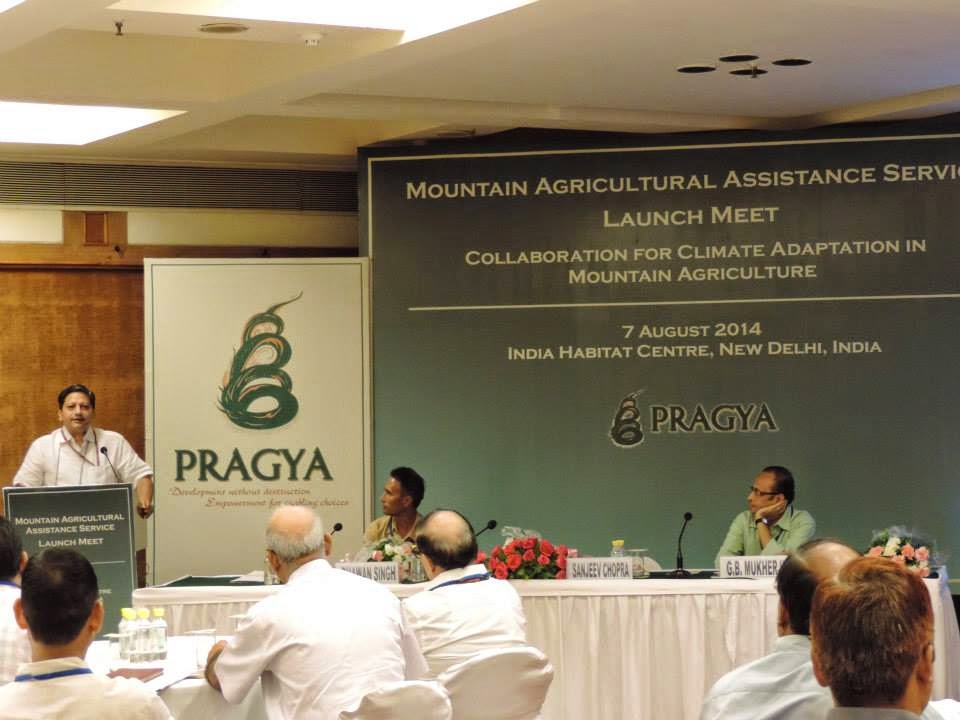 The workshop was designed to facilitate interaction among the participants to document the existing pool of knowledge and support services and draw out recommendations for functioning of the MAAS network and insights on key action options to address food security of the small farmers.
The one-day event began with a brief inaugural session that highlighted the relevance of MAAS network in the current Himalayan context, which was followed by multi-stakeholder deliberations for two sessions: Working session 1: Pathways for Alliance and Working session2: Specific Interventions for Mountain Agriculture.
 The process looked at the issues plaguing the mountain agriculture and posing threat to food security of the small farmers in the region and facilitated cross stakeholder understanding of the issues. The participative process also brought out recommendations for the network functions that are expected to be far closer to the stakeholder needs and area specific requirements.
The post-lunch session saw presentations by technical experts from NCPAH-Ministry of Agriculture, IMD Agro-met Division and SASE on existing support services and potential contributions towards Mountain Agricultural Assistance Service. The event concluded with sharing of results of the deliberations and summarization of the key priorities.
The process looked at the issues plaguing the mountain agriculture and posing threat to food security of the small farmers in the region and facilitated cross stakeholder understanding of the issues. The participative process also brought out recommendations for the network functions that are expected to be far closer to the stakeholder needs and area specific requirements. The post-lunch session saw presentations by technical experts from NCPAH-Ministry of Agriculture, IMD Agro-met Division and SASE on existing support services and potential contributions towards Mountain Agricultural Assistance Service. The event concluded with sharing of results of the deliberations and summarization of the key priorities.
8 July 2014
"Ganga Manthan" dialogue

Research & Advocacy Team of Pragya, participated in national dialogue: “Ganga Manthan" - a multi-stakeholder dialogue, hosted by National Mission for Clean Ganga (NMCG), Ministry of Water Resources, Govt. of India, on 7th July, 2014 at Vigyan Bhawan, New Delhi, India. The event was inaugurated by nion Minister for Road Transport, Highways and Shipping Mr. Nitin Gadkari, Union Water Resources Minister Ms. Uma Bharti. The event was also attended by Union Minister of Environment Mr. Prakash Javadekar. Post inaugural session, the participants were divided into parallel working sessions by stakeholder categories - Scientists, NGOs/Civil Society and Religious Leaders.
The event highlighted the focus of Ministry of Water Resources on 'Aviral aur Nirmal (continuous and clean) Ganga'. The government seeks to provide around 30% cost and plans to raise the rest through public-private partnership (PPP). The discussions focused more on waste water treatment, water sharing issues rather than rejuvenation of water sources. The Pragya member participated in 'Aviral & Nirmal Ganga' session, chaired by: Justice Girdhar Malviya, that was designated for the NGOs & Environmentalists and submitted several recommendations during the consultation.
Pragya works to reach benefits of technology in water sector to deprived indigenous communities. (Read more about our work)
Subscribe to:
Posts (Atom)
When Old Patterns Stop Making Sense: Shifts in Western Himalayan Plant Assemblages, 2020-2024 by Sudipto Majumdar, Pragya T...
-
 The Kesar Saga poem is an eleventh-century Tibetan epic about Kesar, the King of Ling. The story became the national epic of Ladakh, and ...
 -
When Old Patterns Stop Making Sense: Shifts in Western Himalayan Plant Assemblages, 2020-2024 by Sudipto Majumdar, Pragya T...
-
 Nilima Das has been working as a mentor (Missamari village, Sonitpur, Assam) to empower women and to sensitise all stakeholders in the ...
